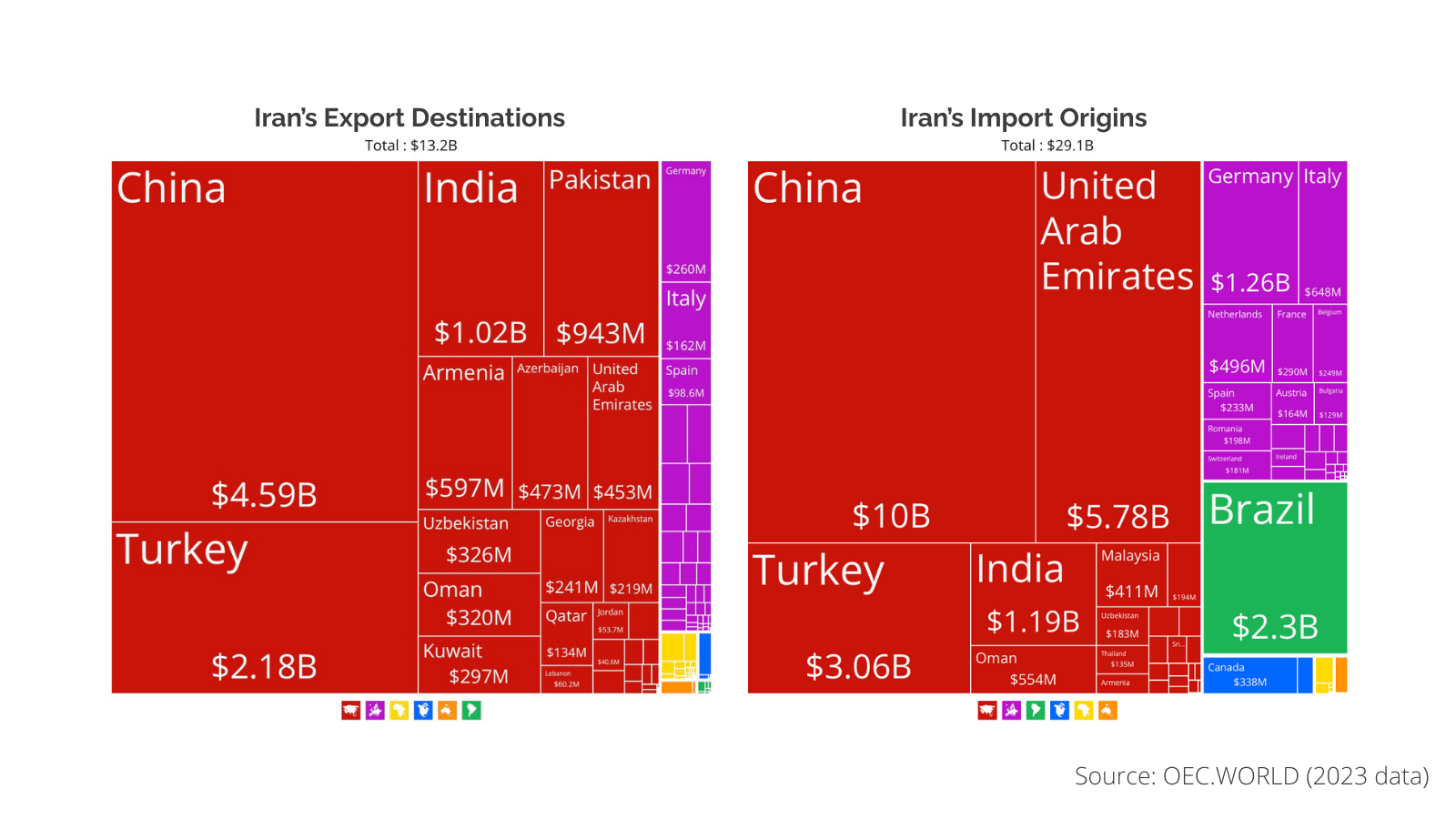
Trump announces 25% tariffs on "any country doing business with Iran". These are Iran's main trade partners Visualization
Data Analysis
What This Visualization Shows
This data visualization displays "Trump announces 25% tariffs on "any country doing business with Iran". These are Iran's main trade partners" and provides a clear visual representation of the underlying data patterns and trends. The visualization focuses on Although details on how this tariff could be implemented or which countries will be affected were not revealed, this Monday the U.S President announced that he will impose a tariff of 25% on any country that does business with Iran. China is currently Iran's largest trade partner, accounting for more than 34% of both imports origins and export destinations for the country.
This measure is set to take effect amid the mass protest Iran's government is facing, resulting in hundreds of deaths and thousands of arrests.
Sources:
Trade data: [https://oec.world/en/profile/country/irn?selector343id=Import&selector1879id=percentage](https://oec.world/en/profile/country/irn?selector343id=Import&selector1879id=percentage)
News Article: [https://www.businessinsider.com/trump-tariff-countries-doing-business-with-iran-2026-1](https://www.businessinsider.com/trump-tariff-countries-doing-business-with-iran-2026-1), which allows us to understand complex relationships and insights within the data through visual storytelling.
Deep Dive into the Topic
Business data visualization transforms raw performance metrics into actionable insights that drive strategic decision-making and operational efficiency. Modern businesses generate enormous amounts of data from sales transactions, customer interactions, marketing campaigns, and operational processes that require sophisticated visualization techniques to extract meaningful patterns.
Sales and revenue visualizations help businesses track performance against targets, identify seasonal trends, and understand customer behavior patterns. Marketing analytics dashboards reveal campaign effectiveness, customer acquisition costs, and return on investment across different channels. Operational data visualization can highlight efficiency bottlenecks, resource utilization patterns, and quality metrics that impact business performance.
The strategic value of business data visualization extends to all organizational levels. Executives use high-level dashboards to monitor overall performance and market position. Managers rely on departmental analytics to optimize team performance and resource allocation. Front-line employees use real-time visualizations to track daily goals and identify immediate improvement opportunities. This democratization of data insights enables data-driven decision-making throughout the organization.
Data Analysis and Insights
The patterns revealed in this visualization demonstrate the importance of systematic data analysis in understanding complex phenomena. By examining different data segments, time periods, and categorical breakdowns, we can identify trends that inform strategic planning and decision-making processes.
Statistical analysis of this data reveals variations across different dimensions that provide insights into underlying drivers and relationships. These patterns help identify areas of opportunity, potential risks, and key performance indicators that can guide future actions and resource allocation.
The analytical approach used in this visualization enables comparison across different categories, time periods, or geographic regions, revealing insights that support evidence-based decision-making. This type of analysis is essential for organizations seeking to optimize performance and understand complex market dynamics.
Significance and Applications
This data visualization has important implications for understanding trends and patterns that affect decision-making across multiple sectors. The insights derived from this analysis can inform policy development, business strategy, resource allocation, and operational improvements.
For analysts, researchers, and decision-makers, this type of data visualization provides essential insights for strategic planning and performance optimization. Whether addressing operational challenges, market analysis, or policy development, understanding data patterns helps create more effective strategies and solutions.
The broader significance lies in how this information contributes to our understanding of complex systems and relationships. This knowledge helps predict future trends, identify potential challenges, and develop more informed approaches to problem-solving and opportunity identification.
Comments
Loading comments...
Leave a Comment
About the Author

Alex Cartwright
Senior Data Visualization Expert
Alex Cartwright is a renowned data visualization specialist and infographic designer with over 15 years of experience in...