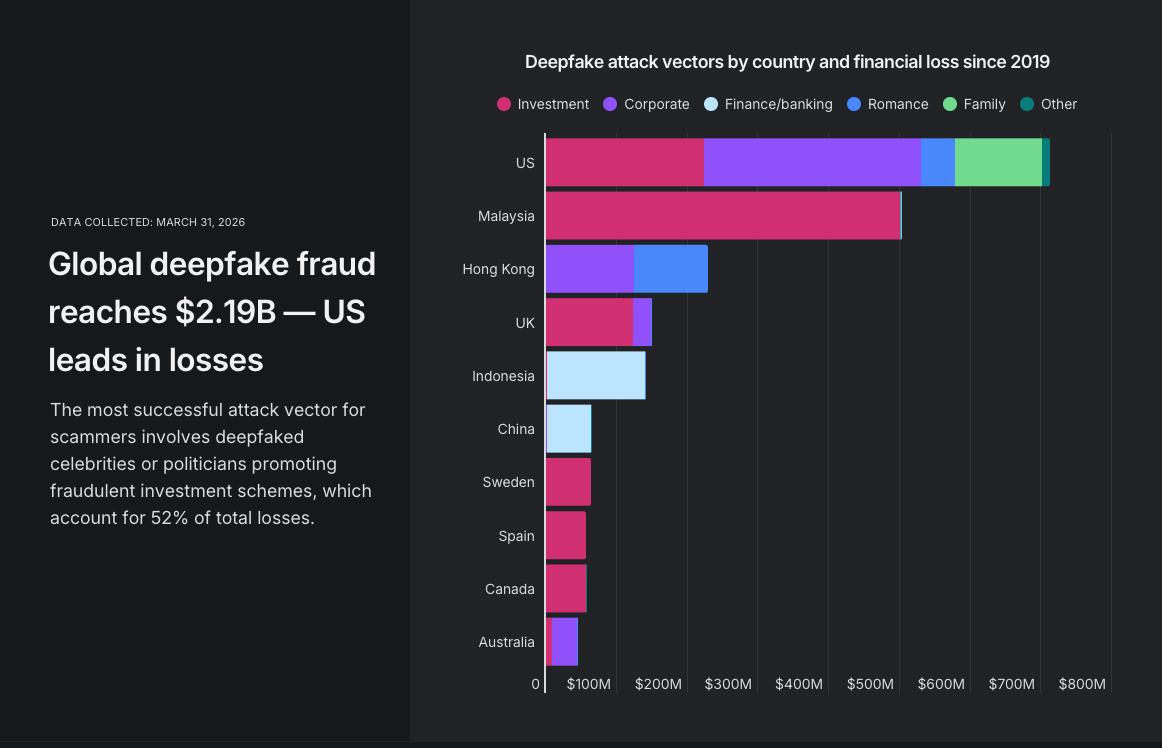
Global deepfake fraud reaches $2.19B — US leads in losses Visualization
Data Analysis
What This Visualization Shows
This data visualization displays "Global deepfake fraud reaches $2.19B — US leads in losses" and provides a clear visual representation of the underlying data patterns and trends. The visualization focuses on **Methodology and sources**
This study used data from the AI Incident Database, [Resemble.AI](http://Resemble.AI), and the OECD to create a combined dataset covering deepfake incidents from January 2019 to March 2026. Incidents were included if they involved the generation of synthetic videos, images, or audio, and were verified by media reports with clearly documented financial losses. Each deepfake incident was then classified by target country and specific attack vector. These figures represent a conservative estimate based on publicly reported data, and the source databases included records of deepfake incidents across multiple languages.
Attack vectors were classified as follows:
* Celebrity fake investment endorsement: incidents where deepfakes were used to create fake endorsements from famous people to promote fraudulent investment opportunities; * Government fake investment endorsement: use of deepfakes to impersonate government officials promoting fake investment schemes; * Romance: general romance scams using deepfakes to create fabricated identities and relationships, not involving celebrities; * Celebrity romance: scams involving deepfaked celebrities used to deceive victims into online romantic relationships for financial gain; * Corporate: attacks targeting organizations, typically through CEO or executive impersonation, to authorize fraudulent transfers or gain access to sensitive information; * Family: scams in which deepfakes were used to impersonate a victim’s relative, often to solicit urgent funds or information; * Finance: incidents focused on financial fraud, such as taking out loans or credit under a victim’s identity, using deepfaked media for authentication; * Extortion: cases where deepfake content was used to blackmail or threaten victims, including using synthetic media to fabricate compromising situations; * Pets: incidents where deepfakes of lost pets were used to demand payment; * Other: cases that do not fit into the above categories, including novel schemes or unclassified methods.
[For the complete research material behind this study, click here.](https://docs.google.com/spreadsheets/d/1jcT8AH59i1f9vecif3TdwJ5F-XES7PJDx8SWvcI6e7Q/edit?gid=1534191446#gid=1534191446)
Data was collected from:
[AI Incident Database (2026).](https://incidentdatabase.ai/)
[Resemble.AI (2026). Deepfake Incident Database.](https://www.resemble.ai/deepfake-database/)[OECD (2026). ](https://oecd.ai/en/incidents?search_terms=%5B%5D&and_condition=false&from_date=2000-03-04&to_date=2026-03-04&properties_config=%7B%22principles%22:%5B%5D,%22industries%22:%5B%5D,%22harm_types%22:%5B%5D,%22harm_levels%22:%5B%5D,%22harmed_entities%22:%5B%5D,%22business_functions%22:%5B%5D,%22ai_tasks%22:%5B%5D,%22autonomy_levels%22:%5B%5D,%22languages%22:%5B%5D%7D&order_by=date&num_results=20)
[AI Incidents and Hazards Monitor](https://oecd.ai/en/incidents?search_terms=%5B%5D&and_condition=false&from_date=2000-03-04&to_date=2026-03-04&properties_config=%7B%22principles%22:%5B%5D,%22industries%22:%5B%5D,%22harm_types%22:%5B%5D,%22harm_levels%22:%5B%5D,%22harmed_entities%22:%5B%5D,%22business_functions%22:%5B%5D,%22ai_tasks%22:%5B%5D,%22autonomy_levels%22:%5B%5D,%22languages%22:%5B%5D%7D&order_by=date&num_results=20), which allows us to understand complex relationships and insights within the data through visual storytelling.
Deep Dive into the Topic
This data visualization represents a sophisticated analysis of complex information patterns that provide valuable insights into underlying trends and relationships. Data visualization serves as a bridge between raw numerical data and human understanding, transforming abstract statistics into comprehensible visual narratives.
The power of data visualization lies in its ability to reveal patterns, outliers, and correlations that might not be apparent in traditional tabular formats. Through careful selection of chart types, color schemes, and interactive elements, effective visualizations can communicate complex information quickly and accurately to diverse audiences.
Modern data visualization combines statistical analysis with design principles to create compelling visual stories. This interdisciplinary approach requires understanding both the underlying data and the cognitive processes involved in visual perception. The result is more effective communication of quantitative insights that can inform decision-making and drive positive change.
Data Analysis and Insights
The patterns revealed in this visualization demonstrate the importance of systematic data analysis in understanding complex phenomena. By examining different data segments, time periods, and categorical breakdowns, we can identify trends that inform strategic planning and decision-making processes.
Statistical analysis of this data reveals variations across different dimensions that provide insights into underlying drivers and relationships. These patterns help identify areas of opportunity, potential risks, and key performance indicators that can guide future actions and resource allocation.
The analytical approach used in this visualization enables comparison across different categories, time periods, or geographic regions, revealing insights that support evidence-based decision-making. This type of analysis is essential for organizations seeking to optimize performance and understand complex market dynamics.
Significance and Applications
This data visualization has important implications for understanding trends and patterns that affect decision-making across multiple sectors. The insights derived from this analysis can inform policy development, business strategy, resource allocation, and operational improvements.
For analysts, researchers, and decision-makers, this type of data visualization provides essential insights for strategic planning and performance optimization. Whether addressing operational challenges, market analysis, or policy development, understanding data patterns helps create more effective strategies and solutions.
The broader significance lies in how this information contributes to our understanding of complex systems and relationships. This knowledge helps predict future trends, identify potential challenges, and develop more informed approaches to problem-solving and opportunity identification.
Comments
Loading comments...
Leave a Comment
About the Author

Alex Cartwright
Senior Data Visualization Expert
Alex Cartwright is a renowned data visualization specialist and infographic designer with over 15 years of experience in...