Starlink subscribers have 4x'd in two years but... Visualization
Data Analysis
What This Visualization Shows
This data visualization displays "Starlink subscribers have 4x'd in two years but..." and provides a clear visual representation of the underlying data patterns and trends. The visualization focuses on SpaceX is going public today. Most people are talking about the $1.75 trillion valuation and how Nasdaq’s rules could trigger $22 billion in automatic index fund buying if SPCX joins the Nasdaq-100, possibly in just 15 trading days.
But I kept coming back to one number hidden in the filing.
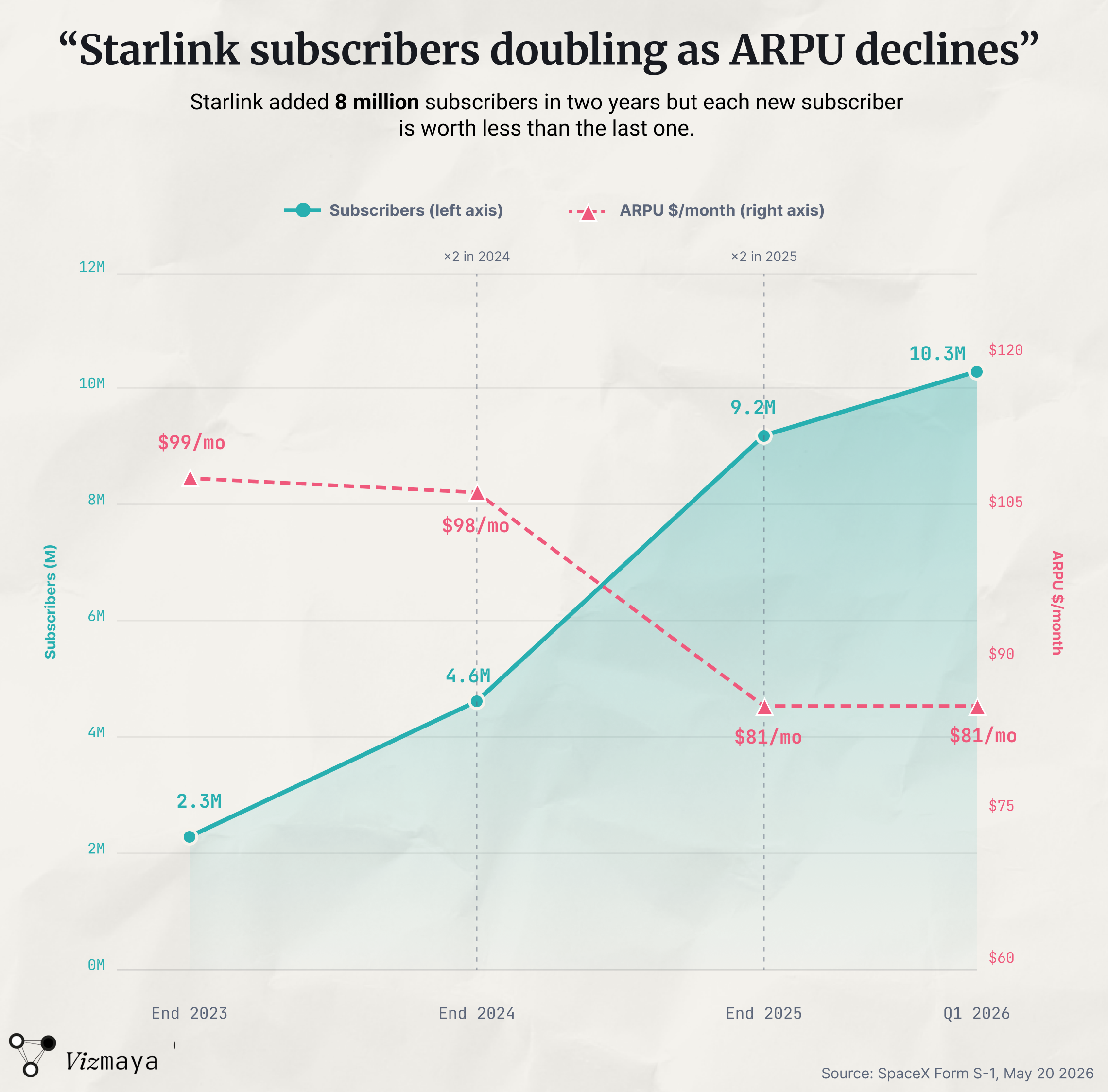
At the end of 2023, ARPU was $99 per month. By the end of 2024, it dropped to $98. It’s projected to be $81 per month at the end of 2025 and in the first quarter of 2026.
During the same period, the number of subscribers grew from 2.3 million to 10.3 million. That’s a fourfold increase in two years. So, the company has four times as many customers but is making 18% less per customer compared to two years ago.
There are two ways to look at this, and honestly, I’m not sure which one is correct.
* One view is that Starlink is intentionally targeting lower-priced markets, offering cheaper plans in places like Africa, Southeast Asia, and rural Latin America. The idea is to gain more customers in price-sensitive areas now, then raise ARPU later once they control the infrastructure. With a 63% Adjusted EBITDA margin in Connectivity, the business appears capable of remaining profitable even at $81 per user. * The other view is that pricing pressure is forcing these changes rather than helping them. Eventually, growing the number of subscribers won’t make up for falling revenue per user, and $1.75 trillion is a high price for a company that hasn’t answered this question yet.
Source: [https://www.sec.gov/Archives/edgar/data/1181412/000162828026036936/spaceexplorationtechnologi.htm](https://www.sec.gov/Archives/edgar/data/1181412/000162828026036936/spaceexplorationtechnologi.htm)
I also put together a full data story with all the charts if the raw filing is too much to handle: vizmaya(dot)fyi/story/spacex-ipo-2026, which allows us to understand complex relationships and insights within the data through visual storytelling.
Deep Dive into the Topic
This data visualization represents a sophisticated analysis of complex information patterns that provide valuable insights into underlying trends and relationships. Data visualization serves as a bridge between raw numerical data and human understanding, transforming abstract statistics into comprehensible visual narratives.
The power of data visualization lies in its ability to reveal patterns, outliers, and correlations that might not be apparent in traditional tabular formats. Through careful selection of chart types, color schemes, and interactive elements, effective visualizations can communicate complex information quickly and accurately to diverse audiences.
Modern data visualization combines statistical analysis with design principles to create compelling visual stories. This interdisciplinary approach requires understanding both the underlying data and the cognitive processes involved in visual perception. The result is more effective communication of quantitative insights that can inform decision-making and drive positive change.
Data Analysis and Insights
The patterns revealed in this visualization demonstrate the importance of systematic data analysis in understanding complex phenomena. By examining different data segments, time periods, and categorical breakdowns, we can identify trends that inform strategic planning and decision-making processes.
Statistical analysis of this data reveals variations across different dimensions that provide insights into underlying drivers and relationships. These patterns help identify areas of opportunity, potential risks, and key performance indicators that can guide future actions and resource allocation.
The analytical approach used in this visualization enables comparison across different categories, time periods, or geographic regions, revealing insights that support evidence-based decision-making. This type of analysis is essential for organizations seeking to optimize performance and understand complex market dynamics.
Significance and Applications
This data visualization has important implications for understanding trends and patterns that affect decision-making across multiple sectors. The insights derived from this analysis can inform policy development, business strategy, resource allocation, and operational improvements.
For analysts, researchers, and decision-makers, this type of data visualization provides essential insights for strategic planning and performance optimization. Whether addressing operational challenges, market analysis, or policy development, understanding data patterns helps create more effective strategies and solutions.
The broader significance lies in how this information contributes to our understanding of complex systems and relationships. This knowledge helps predict future trends, identify potential challenges, and develop more informed approaches to problem-solving and opportunity identification.
Comments
Loading comments...
Leave a Comment
About the Author

Alex Cartwright
Senior Data Visualization Expert
Alex Cartwright is a renowned data visualization specialist and infographic designer with over 15 years of experience in...