Has Generational Progress Stalled? Income Growth Over Five Generations of Americans Visualization
Data Analysis
What This Visualization Shows
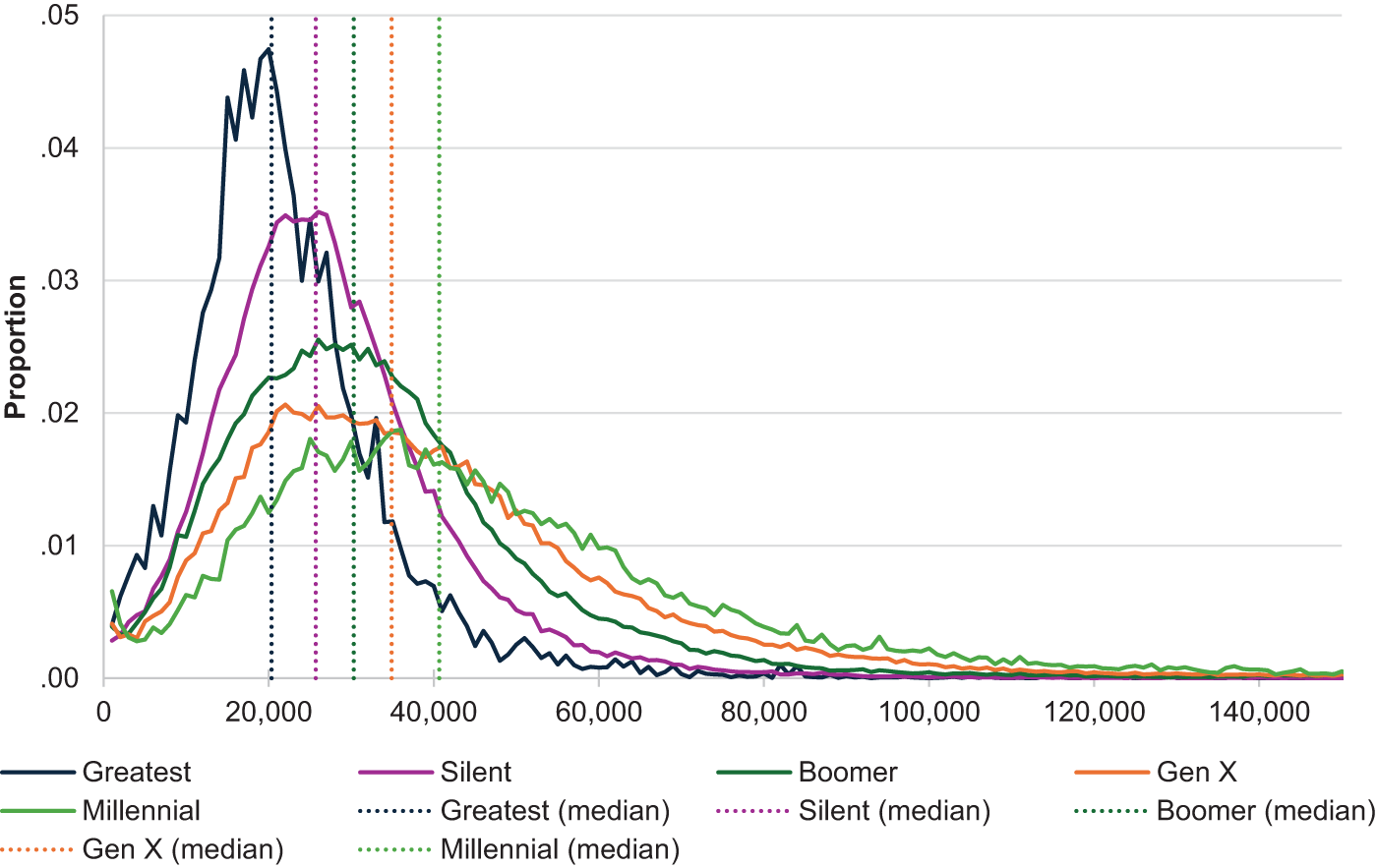
This data visualization displays "Has Generational Progress Stalled? Income Growth Over Five Generations of Americans" and provides a clear visual representation of the underlying data patterns and trends. The visualization focuses on Source: Corinth, K., & Larrimore, J. (2026). Has Generational Progress Stalled? Income Growth Over Five Generations of Americans. *Demography*, *63*(2), 589-616. [https://doi.org/10.1215/00703370-12555050](https://doi.org/10.1215/00703370-12555050)
Figure notes: Distribution of posttax, posttransfer income of individuals/couples by generation, at ages 36‒40. Generations are defined by the following birth years: Greatest Generation (1901–1927), Silent Generation (1928–1945), Baby Boomers (1946–1964), Generation X (1965–1980), and Millennials (1981–1996). Posttax, posttransfer income includes market income as well as all nonmedical cash and in-kind transfers, adjusts for taxes, and excludes the value of health insurance. Income for each individual includes income received by the individual and, in the case of those who are married or in a cohabiting relationship, the total income received by both members of the couple divided by two. All income values are converted to real 2019 dollars using the Personal Consumption Expenditures price index. *Sources:* Current Population Survey Annual Social and Economic Supplement, 1964–2024; Burkhauser et al. (2024); and authors’ calculations., which allows us to understand complex relationships and insights within the data through visual storytelling.
Deep Dive into the Topic
Economic data visualization plays a crucial role in understanding market trends, financial performance, and economic patterns across different sectors and regions. This type of data analysis helps economists, policymakers, and business leaders make informed decisions based on quantitative insights.
Economic indicators such as GDP growth, unemployment rates, inflation, and market performance are complex datasets that require sophisticated visualization techniques to communicate effectively. Interactive charts and graphs can reveal trends over time, compare performance across different markets, and highlight correlations between various economic factors.
The significance of economic data visualization extends beyond academic research. Financial institutions use these visualizations for risk assessment, investment strategies, and market analysis. Governments rely on economic data visualization to track policy effectiveness, plan budgets, and communicate economic status to citizens. Businesses use economic trend analysis to forecast demand, plan expansion, and assess market opportunities.
Data Analysis and Insights
The patterns revealed in this visualization demonstrate the importance of systematic data analysis in understanding complex phenomena. By examining different data segments, time periods, and categorical breakdowns, we can identify trends that inform strategic planning and decision-making processes.
Statistical analysis of this data reveals variations across different dimensions that provide insights into underlying drivers and relationships. These patterns help identify areas of opportunity, potential risks, and key performance indicators that can guide future actions and resource allocation.
The analytical approach used in this visualization enables comparison across different categories, time periods, or geographic regions, revealing insights that support evidence-based decision-making. This type of analysis is essential for organizations seeking to optimize performance and understand complex market dynamics.
Significance and Applications
This data visualization has important implications for understanding trends and patterns that affect decision-making across multiple sectors. The insights derived from this analysis can inform policy development, business strategy, resource allocation, and operational improvements.
For analysts, researchers, and decision-makers, this type of data visualization provides essential insights for strategic planning and performance optimization. Whether addressing operational challenges, market analysis, or policy development, understanding data patterns helps create more effective strategies and solutions.
The broader significance lies in how this information contributes to our understanding of complex systems and relationships. This knowledge helps predict future trends, identify potential challenges, and develop more informed approaches to problem-solving and opportunity identification.
Comments
Loading comments...
Leave a Comment
About the Author

Alex Cartwright
Senior Data Visualization Expert
Alex Cartwright is a renowned data visualization specialist and infographic designer with over 15 years of experience in...